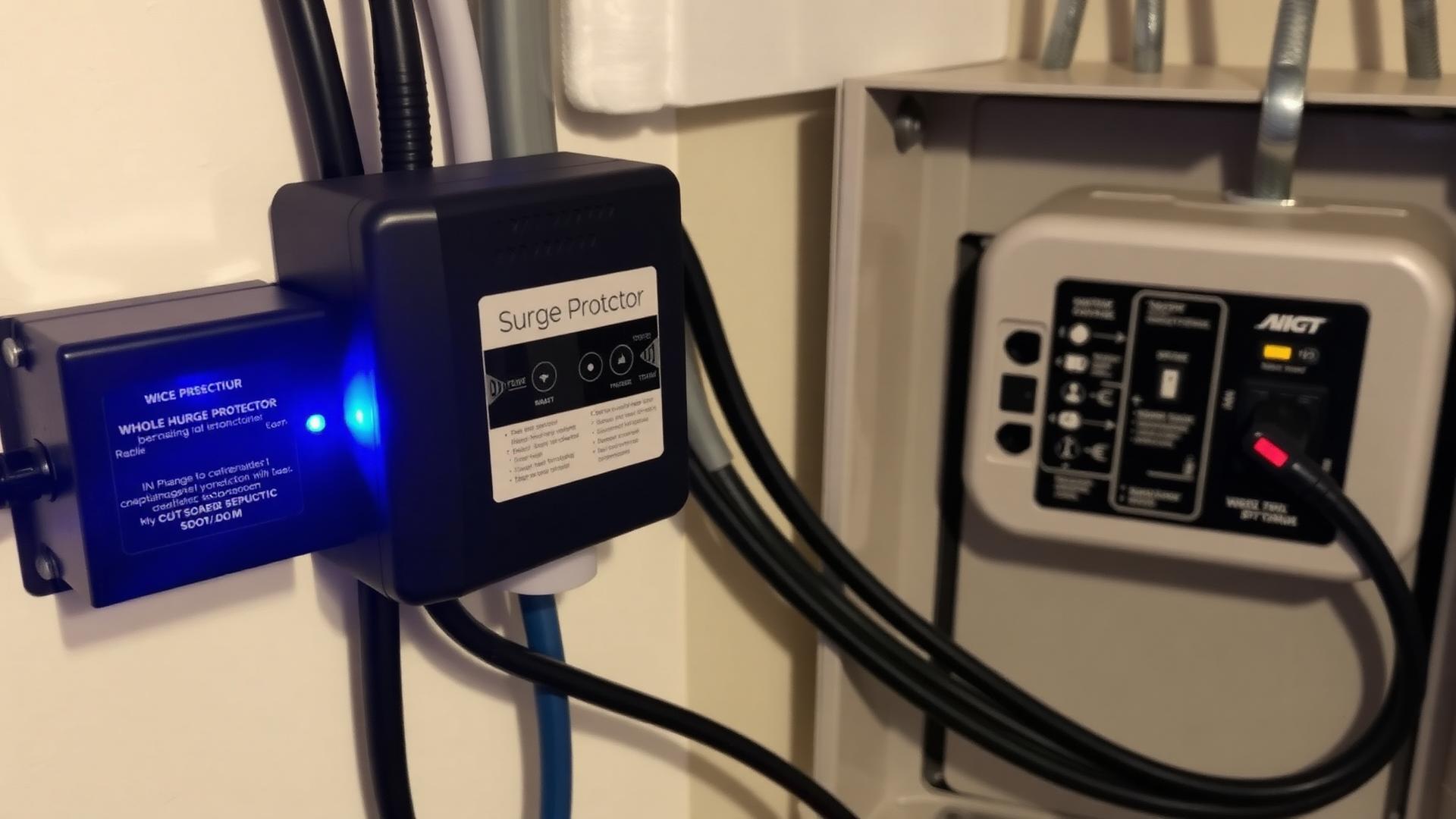
Whole Home Surge Protection
Charleston gets more than its share of summer storms. A single surge can fry your HVAC control board, your smart TV, or your home office setup in a fraction of a second. EmergenServe installs whole-home protection that stops surges at the panel before they reach anything valuable.
One Device. Thousands In Protection.
Most people think of surge protection as a power strip from the hardware store. That helps for a lamp or a phone charger, but it does nothing for your refrigerator, your air handler, your washer, or your water heater. A whole-home surge protector mounts directly at your electrical panel and intercepts voltage spikes the moment they enter your home, whether from a lightning strike, a downed transformer, or the utility grid switching loads.
We install commercial-grade surge protection devices rated for the kind of transient voltage events that are common in the Lowcountry. The install typically takes under two hours, requires no new wiring, and protects every circuit in the house, including hardwired appliances that you can't plug into a power strip.
For homeowners with expensive audio/video systems, home servers, or medical equipment, we also install point-of-use protectors on individual circuits for layered defense. The combination of panel-level and device-level protection gives you the best coverage available.
Whole-home surge protection in Charleston is not a luxury. It's a necessity. South Carolina consistently ranks among the top states for lightning strikes, and the Charleston metro area experiences severe thunderstorms throughout the summer months that send damaging voltage spikes through the power grid. Even without a direct lightning strike, utility switching events, transformer faults, and downed power lines create transient surges that degrade sensitive electronics over time. Our surge protection electricians install UL-listed, commercial-grade surge protective devices (SPDs) rated for Type 1 and Type 2 applications, providing maximum joule absorption at your electrical panel. We also verify your home's grounding electrode system meets NEC requirements, because a surge protector is only as effective as the ground path behind it. Charleston homeowners on Sullivan's Island, Isle of Palms, and other barrier islands face even higher exposure to storm-driven surges, making panel-mounted surge protection essential for protecting HVAC systems, smart home equipment, and appliances worth thousands of dollars.
Surge Protection Services:
- Whole-home surge protector installation
- Panel-mounted surge protection devices
- Point-of-use surge protector installation
- Lightning surge protection systems
- Surge protection for HVAC systems
- Surge protection for home theater and electronics
- Surge protection for pool and spa equipment
- Existing surge protector inspection and replacement
- Grounding system evaluation and upgrade
- Insurance documentation for surge protection
Why It Matters In The Lowcountry
Lightning Alley
South Carolina ranks among the top states for lightning strikes per year. Your home needs frontline defense.
Silent Damage
80% of surges are internal. Your AC compressor cycling creates small spikes that degrade electronics over months.
Pennies Per Day
A whole-home protector costs less than a single appliance repair. It pays for itself the first time it fires.
Storm Season Is Coming. Are You Protected?
A two-hour install now could save you thousands in fried electronics later. Let's get your home covered.
Charleston is one of the most lightning-prone metropolitan areas on the East Coast. The Lowcountry averages 50 to 70 thunderstorm days per year, and a single direct strike on a Dominion Energy distribution line can send a 30,000-volt transient through every outlet in your home in a fraction of a millisecond. Whole-home surge protection is no longer optional, it is the baseline of any well-designed Charleston electrical system. EmergenServe installs UL 1449 Type 1 and Type 2 SPDs from Eaton, Square D, Siemens, Leviton, and Intermatic across Charleston, Mount Pleasant, Daniel Island, James Island, Johns Island, Isle of Palms, Sullivan's Island, North Charleston, West Ashley, Summerville, Goose Creek, Hanahan, and Moncks Corner.
How Lightning & Power Surges Damage Charleston Homes
A direct lightning strike is the most dramatic source of electrical damage, but it is far from the only one. The vast majority of damaging surges in Charleston homes come from indirect lightning, utility switching transients, downed lines, capacitor bank cycling, and your own large appliances cycling on and off. Every time your central AC compressor, well pump, refrigerator, or pool pump kicks on, it generates a small inductive surge that travels through your home's wiring.
Sensitive modern electronics, smart TVs, gaming consoles, computers, smart thermostats, LED lighting drivers, EV chargers, and variable-speed HVAC equipment, degrade with every surge they absorb. Without surge protection, these devices fail prematurely and the cause is rarely identified. With layered surge protection, their lifespan is dramatically extended.
Layered Protection: Type 1, Type 2 & Point-Of-Use SPDs
Effective Charleston surge protection requires a layered defense, not a single device. Type 1 SPDs install on the line side of your main breaker, between the meter and the panel, to absorb the largest external surges from lightning and utility events. Type 2 SPDs install inside the panel and provide secondary protection for branch circuits. Type 3 point-of-use surge strips at sensitive equipment provide the final layer of protection.
EmergenServe typically installs a Type 2 SPD at the main panel as the primary defense, and recommends Type 1 SPDs on the meter base for homes in high-strike zones like the Isle of Palms, Sullivan's Island, Folly Beach, and waterfront Mount Pleasant. We also install dedicated SPDs for outdoor units (HVAC condensers, well pumps, EV chargers) which are particularly vulnerable to direct strikes.
- Eaton CHSPT2ULTRA Type 2 panel-mounted SPD
- Square D HEPD80 panel-mounted protector
- Siemens FirstSurge FS140 whole-home SPD
- Leviton 51120-1 Type 2 surge protector
- Intermatic IG3240RC3 outdoor meter-mount SPD
- HVAC condenser dedicated surge protection
- Generator transfer switch surge integration
- Coaxial, ethernet, and phone line SPDs
Storm Season, Hurricanes & Charleston-Specific Risks
Hurricane season runs June through November in Charleston, but the most damaging electrical events often happen during routine summer afternoon thunderstorms. When Hurricane Hugo, Matthew, Dorian, Idalia, or any major tropical system rolls through the Lowcountry, post-storm power restoration generates massive switching transients as Dominion Energy re-energizes circuits. Homes without surge protection routinely lose entire racks of electronics during the restoration phase, not the storm itself.
EmergenServe pairs whole-home surge protection with generator installation as a complete storm-readiness package. The combination protects against both extended outages and the dirty power that often accompanies them.
Warranty, Replacement & Joule Ratings Explained
Quality SPDs come with manufacturer-backed connected equipment warranties, typically $25,000 to $75,000 in covered equipment damage if a properly installed SPD fails to protect your home. EmergenServe registers every SPD installation with the manufacturer to activate this warranty on your behalf.
SPDs are rated in joules, the total energy they can absorb before they need replacement. A quality whole-home SPD is rated 40,000 to 80,000 joules. Most have visual indicators (a green LED) showing they are still functional. After a major lightning event, the SPD may have absorbed enough energy to need replacement; the LED tells you immediately. EmergenServe checks SPD status during every service visit and offers periodic SPD inspection as part of our annual maintenance program.
How We Install A Whole-Home SPD The Right Way
We've installed enough Eaton CHSPT2ULTRA and Square D HEPD80 units in Charleston panels to know what separates an effective install from a bracket-mounted box that does nothing. The single biggest mistake we see is lead length. Every inch of conductor between the SPD and the bus bar adds inductance, and inductance dramatically slows the SPD's clamping response, a unit installed with 18 inches of looped lead can let through a transient that a properly mounted SPD would have absorbed. We mount our SPDs directly adjacent to the main breaker, with leads cut as short as physically possible, twisted together to cancel the surge field, and landed on a two-pole breaker on the line-side of the bus.
On the meter base we install Intermatic IG3240RC3 or equivalent Type 1 SPDs ahead of the main, especially for our Isle of Palms, Sullivan's Island, Folly Beach, and Daniel Island clients who sit in some of the highest lightning-strike density in the Southeast. We also bond every coax, ethernet, and incoming phone line to the same ground point as the panel, because the surge will find the weakest path, and an unbonded cable line is a 40-foot lightning antenna pointed at your TV.
Frequently Asked Questions
How much does whole-home surge protection cost in Charleston?
A typical Type 2 panel-mounted SPD installation in Charleston runs $350 to $650 fully installed. Adding Type 1 meter-base protection adds $300 to $500. Layered systems with point-of-use protection at HVAC and EV chargers run $800 to $1,500.
Will surge protection stop a direct lightning strike?
No SPD can fully absorb a direct strike to your home, but properly layered protection will dramatically reduce damage from indirect strikes, utility transients, and the much more common everyday surges that account for over 80% of electrical damage in Charleston.
Do I still need surge strips at my electronics?
Yes. Layered protection is the gold standard. Whole-home SPDs absorb the large external surges; point-of-use surge strips clamp the smaller residual transients before they reach your sensitive electronics.
How long do surge protectors last?
Quality SPDs typically last 5 to 10 years under normal Charleston conditions, but a major lightning event can deplete them in a single strike. The status LED tells you when replacement is needed.
Does my homeowners insurance require surge protection?
Not currently, but many South Carolina insurance carriers offer discounts for homes with whole-home surge protection installed. Ask your agent, the discount often pays for the SPD within a few years.
Service Areas & Specialties
Charleston whole home surge protection · lightning protection Charleston SC · Type 2 SPD installation · Mount Pleasant surge protector · Daniel Island lightning protection · Isle of Palms surge protection · panel mounted SPD Charleston · Eaton CHSPT2ULTRA installer · Square D HEPD80 install · hurricane surge protection SC · HVAC surge protector Charleston · Dominion Energy transient protection